Thursday, 16 May 2019

Wild Camping in Scotland (some do's and dont's)

One of 31,460 beautiful Lochs!


I am first to trumpet the beauty of our Scotland. It's stunning. Glencoe is breathtaking, Killin is stunning, The Cairngorms are like unexplored diamonds and the Highlands are like no other country on earth. Even the lowlands and the central belt wield some spectacular sights... not to mention some of the best crystal specimen locations in the world...

...But should you want to go exploring (and I wholeheartedly encourage you to do so) there are a few rules you should follow, just to keep you safe and out of trouble. Upsetting the locals is a sure fire way to never be invited back. Well this last few weeks I had the pleasure of going on my first wild camping trip of the season, something I do often and without real consideration for my safety. I love a good campfire; but I sleep with my rock hammer by my pillow *just* in case. At least we don't have any wolves... yet.

So let's dive in and get to work. Just because we don't have wolves doesn't mean it's safe and tame. Here are a few do's and don'ts for wild camping in Scotland that should keep you safe.

Rule Number 1: Do Avoid Pine Forests


 The Scots pine (and other assorted, non-native pines) make up many of our forests. They look pretty, are home to loads of wildlife and the bed of old needles looks soft and inviting to any camper having to sleep on a roll mat on the ground.

While truly comfortable to sleep on; pine forests in Scotland aren't 'tended' at least for the most part. One of my favourite forests at Braidwood has two unofficial woodsmen - and I've still seen fully grown trees blow over on a windy day. The taller the pines the more likely they are to fall on you. The winds get high up here.

Don't fall asleep in a pine tree forest unless you want to wake up with a tree on your tent. OK, so the chances are slim, but any chance is too much when you are out of mobile and Internet range.

Rule Number 2: Don't Camp In Someones Farm/Land/Garden Without Permission


This sounds like common sense but it's not. Really. There are vast areas of Scotland known as 'common ground' and these areas belong to the common... that means everyone. Quite often you find these areas in deep forest, in the middle of nowhere or on the side of mountains.

It's fairly easy to tell whether or not you are on someones land. If you are a stone's throw from a town, village, or property then you are probably on owned land. If you are in a field - owned land. If you are in an area marked by a boundary like a fence then you are probably on owned land. If the remains of a five hundred year old stone dyke mark the land then you might be safe.

There are two rules of thumb. 1: use Google Earth or the satellite view function on Google Maps before you go and pick a large area you can camp in. They are easy to find because there is no farmland and it looks like scrub on the map. Stick to this area and you should be OK. 2: Do not start a fire within view of any houses. You also need to be more than fifty meters from a roadside to BBQ or burn. There are a few other fire rules, let's do them next.

As an additional, don't camp too close to reservoirs... you don't want to be accused of tampering with the water supply!

Rule Number 3: Do Have A Fire!


By all means, have a fire! Just make sure you do it safely. Dig a small ditch, ring it with big stones and keep the flames inside the stones. Easy! Not only does this help contain the flames it also builds a pit of ash in which your ashes will stay warm as long as possible. The ashes at the bottom of the pit should only need a stir and some kindling to get going again.
  • Don't start a fire near houses or within sight of a road.
  • Do use other people's fire pits before starting one of your own. Chances are other people will have camped where you are and will have left traces. Wood that has been burned before, and charcoal, will light faster than a fresh pit (plus it's better for the environment).
  • See this article for instructions on effective fire lighting.
  • Take TWO lighters, firelighters and an old notepad you don't mind burning for help to get it going.
  • When it is raining, the bottom branches of a pine tree will be shielded from the rain by the thick branches above. These are perfect for starting a fire in the wet.
  • If you don't have a fire a disposable BBQ is fine - but TAKE IT AWAY WITH YOU! I pick up one of these a week.
  • Better yet, pick up a small portable cooker that works on a gas bottle. They are cheap and make sure you always have hot food, even in the rain.


Rule 4: Don't Let Your Animals Wander


Kai in the Ochils last year
Dogs are the goodest and purest creatures on this earth; but any dog is tempted when a fat sheep wanders over. Don't let them off the lead if they are prone to chase, and sometimes even if they aren't. There are still parts of Scotland where dogs chasing sheep will be shot dead by the farmer - and not just in the highlands, but in the central belt.

Sheep worrying is a big problem in Scotland and we need to be careful. If your dog chases a pregnant ewe she can miscarry, even though you may think your beloved pooch has done no harm. If they are in the tent be sure they can't escape (the little b$gger above can slink under the door of my tent!) and if they are outside keep them on the leash.

Rule 5: Do No Harm.


Rather like the Hippocratic Oath a Doctor takes the first and foremost rule of wild camping in Scotland is that you do no harm. Respect your surroundings. We have the freedom to roam in this country and the common belongs to all of us - but the second you damage property you are in the wrong and may be asked to leave.

This means making sure all fires are properly extinguished before you move on, damaging no crops and hurting or scaring no livestock. When you cut through a field you don't trample it, you go around the side. There is no law preventing you from crossing someones land to get to where you are going - unless you do damage. So don't do any damage and you should be fine!

Rule 6: Do Leave Everything As You Found It!


Waterloo pond... one of our few flat waterways
The most important thing is that you leave everything as you find it. If you can put that fire out and prevent a forest fire, then take down your gear and get off without leaving the place looking a mess then you have obeyed this rule.

We are big on litter picking right now (and hopefully forever more) so take all your rubbish with you. If you are camping in an area you have particularly enjoyed, then picking up any litter others have left is a great way to say thank you to the land that has homed you.

Rule Number 7: DON'T Camp From October To March


You can get away with it in the lowlands, but people die doing this. It's cold. If you don't have proper gear you just can't do it. What you can do is look up one of the many bothies and use the building (if you really must have some free camping in the winter) but even I don't do that and I consider myself pretty hardened.

I can't stress this enough... don't camp in winter. If you absolutely must then take a double skinned or army grade tent, a winter sleeping bag (not just a normal one, you will freeze), plenty of fire materials and a few emergency blankets. I would also suggest some thick bedding to put something between yourself and the ground. I use a heat reflecting roll mat, but it's nowhere near good enough for winter in Scotland. Prepare as if you are going on an arctic expedition and you might just live to tell the tale...


Rule Number 8: Obey Camping Protected Areas


These are assigned by the Forestry Commission (and other governing bodies) to protect particular stretches of land, species or habitats. They also cover areas of Special Scientific Interest, which you can camp on but which you need to check the individual rules of before you go.

Put simply, check the area you want to wild camp on Google just to be sure there is nowhere to avoid. Get a feel for the area before you go, stop yourself wasting time hunting for a good spot and make sure you aren't on a camping protected area before you go. Google is great. Often, you can find other wild camper's have reviewed particular areas and this can give you inspiration.

A Few More Hints And Tips


  • Stay out of the wind if you can, it gets bad on hillsides, look for a valley and camp on the side of it.
  • There aren't always trees - and even if there are you should damage healthy branches for burning. One of these camping stoves or a bag of kindling is a good backup just in case, and picking up wood from the forest floor is fine.
  • Always tell someone where you are going and when you expect to be back.
  • Invest in a solar charger for your phone. Many places in Scotland are off the Internet grid - but you can usually make a phone call in an emergency.
  • Don't go alone (I'm never alone with Kai!) but if you do make sure people know where you are.
  • If you find one of these:

                                                 ...There are people around and possibly drunks. Move on.
  • Avoid electric fences/try to cross at turnstiles. Because common sense said so.
  • Never pitch your tent at the bottom of a valley, you may wake up wet or far downriver.
  • Try to pitch your tent with the door at an angle, if it faces uphill you may be flooded out.
  • Take extra water, you will always use more than you think you will.
  • Put a light on your pet. I'm serious...


Until next time - enjoy camping season! I've already got my bags packed...


Wednesday, 27 February 2019

Ben Nevis...without the hike


Ben Nevis (and Kai)
So I booked an overnight stay up north this week to go have a look at some crystal sites. I found one or two interesting nooks on my travels; but I didn't turn up much in the way of rocks... however, on my way back down I swung over to Glencoe (which will get a blog of it's own for Clan reasons) and saw a sign for Ben Nevis.
View from the parking lot

Well you know me... I can't pass up the opportunity to drive up a mountain. Ben Nevis is the highest mountain in Scotland and it has a year-round activity centre. With it being a fine February day I decided to go have a look. There's bound to be some interesting rocks up there, right?

So we reach the activity centre and there isn't really anywhere else to go. The other road leads to a working quarry and they don't like people like me sniffing around without a hard hat and a high viz vest on. So we pulled up in the car park and went for a look.

The Top Gondola Station
Luckily for me there is a cable car you can take halfway up the mountain... I originally thought it took you all the way up but nooooo. 650m out of a possible 1,344m (which is 4,406 ft). The photograph on the right is the top 'Gondola' station. They say they are the only mountain gondola ride in all of Scotland and I see no reason to disbelieve them.

However strangely, there is also a restaurant in this building (I kid you not) and a 'summer chair' lift that you can take out over the forest. I had Kai so that was a no-go. From this halfway point you can also take a chair lift up to the slopes. It's been dry for days but there was still snow up there.
If you look real hard you'll see my car!
In Scotland we call all mountains over a certain height 'Ben'. If you follow the blog you will see that I visit Ben Lawers quite often (and stopped on the way past this time!) and you might wonder why. The simple reason is that 'Beinn' is the Gaelic word for 'mountain'. In Gaelic the mountain is actually called 'Nibheis' meaning venomous or malicious. Why? It's the most hostile mountain in Scotland. It's the biggest, it's the hardest and it's the one we have fought the longest to tame. Every so often it still kills people.

Getting closer...
As recently as New Year's Day 2019 a young female student plummeted 500m to her death while climbing Carn Dearg (not to be confused with Carn Dearg to the north. Mountain Coward Adventures have a great slide show of this ridge for those interested in climbing it...carefully). A month beforehand another student plunged 1,600ft and sadly didn't make it. This student was an experienced mountaineer. This incident happened when he and his buddy were trying to climb an overhanging ice cornice in Tower's Gully. The Tuesday before that another couple were stranded and needed rescuing from the pitch black, icy conditions. I can't even imagine how terrified they must have been. The mountain really is as malicious as its name makes out.
The first peek over the trees

Ben Nevis isn't alone either. The winter before last there were a reported ten deaths in the mountains in Scotland - one of them in the seemingly tame Ochil hills where I spent my holiday. It's kind of scary. The most obscure death I have heard about was when the body of a Derby man was recovered from an isolated Bothy on New Year's Eve in 2012. This particular man had gone to live for a year off the land and decided to do so in the Highlands of Scotland in November. Do we need to establish ground rules?

When you get to the top there are more hills!
I am the first to point out what a beautiful country we have... but it's deceptively cold and especially at height. Summer is a great time to visit, Spring is glorious (or wet) - even September and October are awesome for climbing. But it takes a certain type of madness to go for the summit in November, December, January or February. That being said Ben Nevis is the best mountain in the UK for ice climbing; hence why there are so many experienced climbers up there in all weathers. As you can see - even the experienced ones run into trouble so the rest of us need to be extra careful.
No seriously... like another 800m of hills...
As usual I am getting a little grim. I don't mean it there's something wrong with my storytelling ability. It's set to 'dark' permanently. Really there are all sorts of fun things to do on the mountain, you just have to be aware of the caution. There is a treetop adventure course, mountain biking, skiing and snowboarding, you can hike it, you can chair it, you can eat... the two ladies in the gondola next to me didn't even get out, they were just eating sandwiches and drinking tea from a bright red flask.
...so...many...more...hills...

Now my days of hopping out and climbing the mountain are over, plus I really wanted to get to Glencoe (my grandpa's middle name was Campbell, there's a story in there somewhere) but I did get a few pictures of what you can see from the way station. On top of that there is a wee video of us on our route up in the cable car that might give you a laugh or two. Kai seemed to like it. I didn't so much. I'm freakin' terrified of heights but the chance was too good to pass up. I'm a coward but a few likes on the Facebook page gave me enough courage to go for it!

Bit of a hazy day...that view though!
Hopefully you will be able to zoom in on the picture on the left and get an idea of how far you can see. The video demonstrates it a little better. They say that on a clear day you can see for up to 125 miles. They also say that it is one of the Three Peaks National Challenge mountains. This challenge sees climbers tackle Ben Nevis, alongside Mt. Snowdon in Wales and Scafell Pike in England. Climbers do all three of these mountains within 24 hours or it doesn't count (including travel time). My conclusion? Mountaineers are madder than crystal hunters by about 800 metres, give or take a few thousand feet.

Last but not least: there's no way I was going all the way up there without getting a look at the rocks! I found a small stream and had a paddle around to have a look. I expected to find tough granite but instead I found a sort of talc substance which had flecked off all through the soil. There is a lot of pink granite in the water, a few pieces of quartz and a lot less of the sparkly, schist/mica type of material you find all around that area. I nabbed one or two to bring home simply to say I have a rock from Ben Nevis, but neither are spectacular. I learned afterwards that basalt and granite are the two main groups up there. Interesting fact: the last ice age wasn't thick enough to cover the summit of Ben Nevis. Most of the mountain is igneous and, according to Ben Nevis.com itself, the mountain is about 400 million years old... that's some pretty ancient granite in my kitchen.

I think that is enough for one page. I'll get to Glencoe at some point... Though Is still have to write about Dunure castle... the locations are stacking up!


The standard Kai pic. Think he enjoyed himself.


Thursday, 14 February 2019

Ardrossan Castle...is it Haunted?


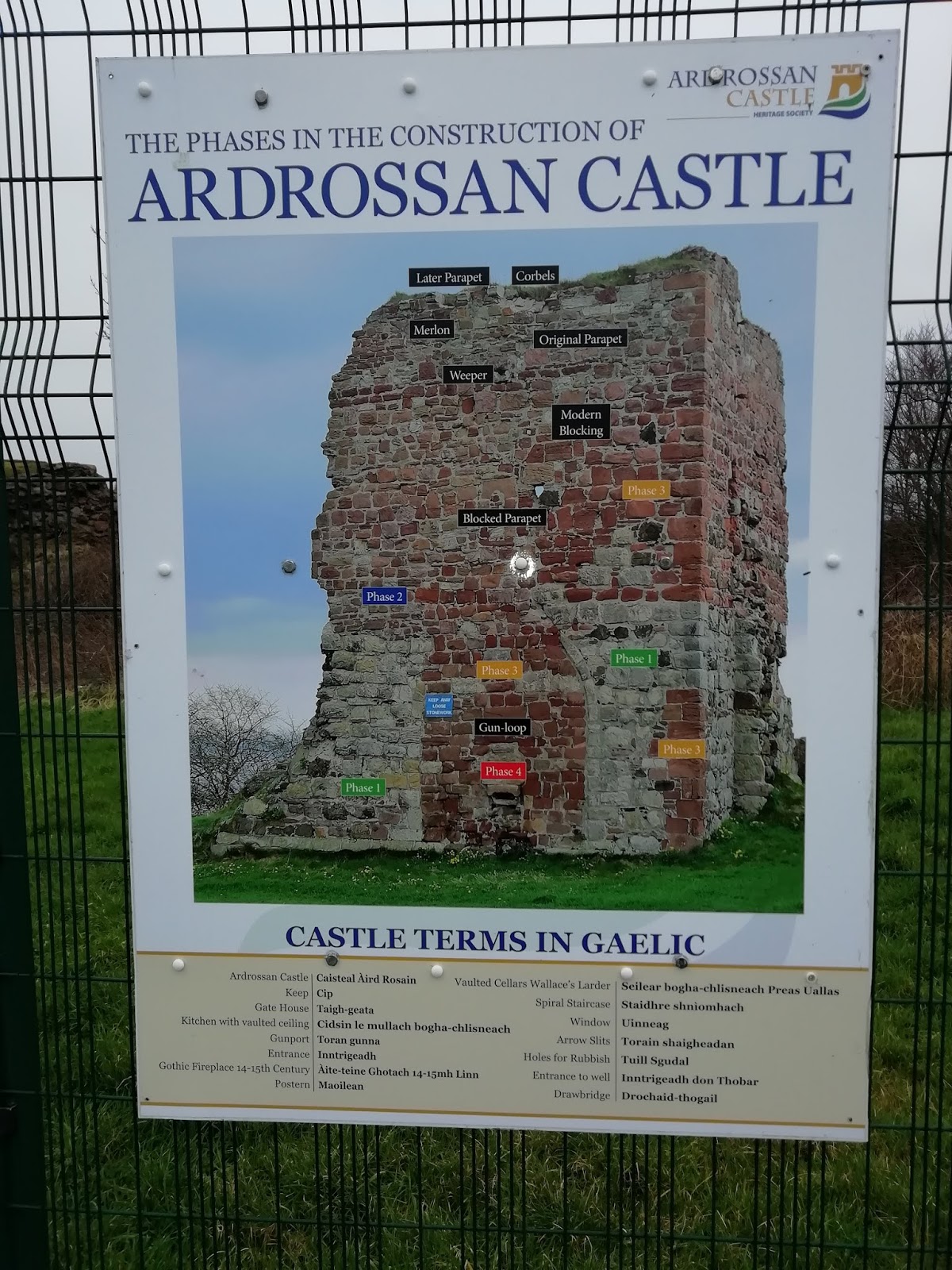
Ardrossan Castle: I had to stick my hand through the bars in the fence to get a good shot.

I know posts have been a little slow so far this year. I've had a few health issues that have kept me indoors. I've resolved to take better care of myself because i get severe cabin fever. So instead of my planned trip gold panning this week I took the physically easier option of going on a mini road-trip.

I headed west for a change, sick of not finding the Elie Bay Rubies I've been out three times to look for. I decided instead of doing anything strenuous I would find something creepy to go look at - and that's how I ended up at Ardrossan Castle.

Ardrossan Castle sits on Canon Hill; a ridge above the town itself. Visible from the bay at Saltcoats (a popular tourist town) it was first constructed in the 12th century. It was partially destroyed after the Scottish Wars of Independence and then it was rebuilt by the Clan Montgomery in the 15th century - only for Oliver Cromwell and his cronies to come along a couple of hundred years later and steal all the masonry to build the Ayr Citadel. The less said about this historical fiasco the better.

What interested me in this tourist spot was not the history - but the legends! In my constant quest to find spooky locations I came across a story about William Wallace wandering the ruins on stormy nights. Now I have lived in both Ayr and Lanark: two very creepy towns both associated with Wallace. So it peaked my interest. There is a second legend regarding a famed horseman known as Sir Fergus Barclay. Nicknamed the De'il o' Ardrossan, this man reportedly traded his soul with the devil in order to be a better horseman. The Devil gifted him a magical bridle which allowed him to become famous - but Barclay later tricked the devil into giving back his soul. In anger the devil attacked his castle, leaving his hoof prints embedded in the very stones themselves.

As well as the lovely view and the castle (which is now all sealed off from the public because it is in ruins, although you can walk around the fence) there is a monument up there. This was erected to Alexander MacFadzean (pronounced Mac-Fad-Yin) in the 19th century. Dr MacFadzean contributed to turning the town into a Burgh, helped install a police station, contributed to the gas, water and electricity supply outside of town and was a general all-round good guy. A monument seems fitting.

Alas I saw no hoof prints, saw no ghosts, and the spectacular view from whence I should have been able to see Arran, the Ailsa Craig and other stunning craggy mountains actually looked like the photo on the right there because it was windy and miserable. I'm sure it's stunning on a nice day!

So After a look around and a bit of a climb I got back in my car and headed down the coast to Dunure... which also has a castle and which deserves it's own page. Until next time; happy crystal hunting, Scotland loving and writing... you are a truly diverse bunch!


Wednesday, 23 January 2019

A Walk Round Wilsontown

(What's left of) Wilsontown Inn as seen from approach

So, after a pretty heavy week and having to replace a smashed laptop screen (thanks Spelectronics, I'm lost without a laptop)I finally managed to do something productive.

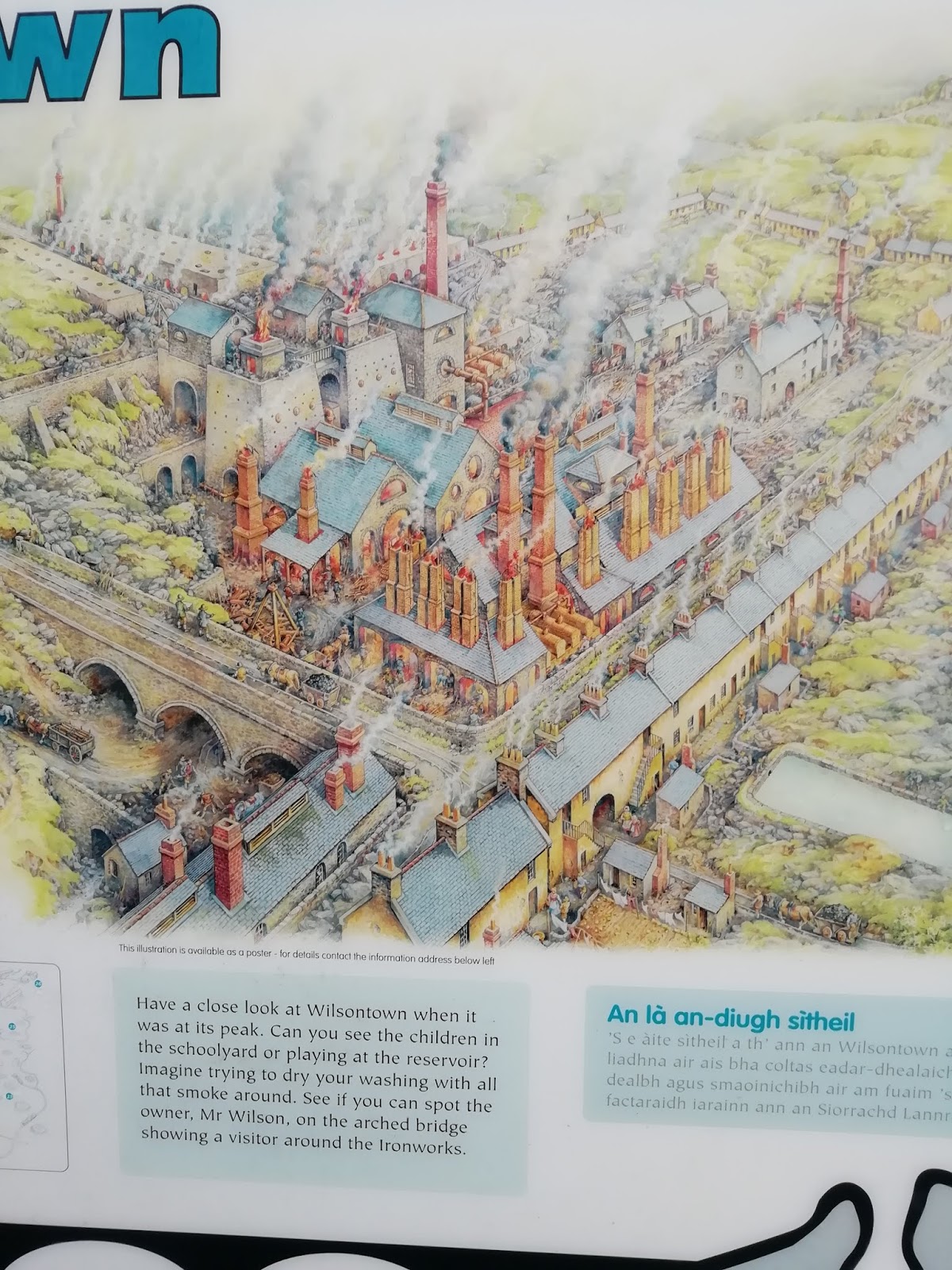
How it once looked...
...Versus how it looks now...
I have been out to Wilsontown (Forestry Commission)before out of curiosity. It is an old Iron mining village nearby where I live in central Scotland that has been preserved to a certain extent. Really it's a nature reserve now, home to some lovely animals which I will attempt to spot for you in the summer and the property of the Forestry Commission. As it was I was walking the dog at another local beauty spot (Braidwood Pond, Carluke Gazette) and met a man who was born and raised in Wilsontown. He was able to tell me that it was a true iron mine and they pulled the ore out of the ground and processed it in the same place...so I had to go back for another look.

looking over the car park where they added a picnic area
It was cold, it was dreary, it was a typical Scottish January out on the moors that make up most of the surrounds to Wilsontown nowadays. The theory I am working with is that where you find Iron deep down in the Earth's crust, is the same area that you find gold. Now people have published all sorts of theories (Science Daily) on this and I find it interesting. It happens that when iron miners do find deposits of placer gold they tend to be so small that they are not worth commercial mining, So...I put two and two together and arrived at the idea that where there are iron mines there might well be gold in the water... even though Geology Scotland says there are no gold faults between the lower highlands and the southern uplands...

Ya never know unless ya try, right?

kai at the start of the pathway.
Unfortunately since this area is a nature reserve there is no way in all the hells I would attempt to pan it. Upstream or downstream perhaps, but having checked it out the water is still pretty polluted. There is a lot of rust, iron waste, smelt, rubbish and all sorts of bits of yuck in there that you don't want to put your hands anywhere near. Certain places are not safe to pan because Tetanus.

What I did find, however, was an astonishing little site where you can walk around and get a real feel for what a working mine might have operated like. You can still see the piles of tailings from where discarded rock was dumped on site. Some of the buildings are still standing, although they are unanimously in a state of disrepair. The best preserved of these is the Wilsontown inn, probably the last building to fall silent when the site closed down in 1955. Scotland suffered a huge industrial setback around that time that saw many of our industries suffer... It was a long, bleak period for us that culminated in the emergence of Thatcher. But the less said about that the better. This is not a political blog!
a commemoration of the achievements of the workers

There is some interesting artwork cast into metal on the gates that makes for nice photography...probably...if you don't have shaking hands and no eye for it...Kai had a good sniff around though. As you walk around you come across conveniently placed noticeboards that tell you a little about the history (3D CAD). A total of three inventions were created here, one of which was the warm air introduced into the furnace made better iron than cold air, which all ironworks previously believed. The forestry commission did well to commemorate this little piece of history in plaque form when they planted the trees back in the early 90's.

Definitely of interest to my rock loving brain was the format of the land. Even as you turn the first corner you can see the dips and furrows where things used to be. At times there are circular dips in the ground that you cannot explain and there are signs warning you to stick to the path. This whole area is subject to pitfalls (there was one in Glasgow very recently) where the ground simply caves in due to the tunnelling underneath. At any rate when you look over the land you can see the shape of how things used to be.

There is a lot of history in this place, from the wounded burn that runs red in places to the other side of the car park, where people still live and where nature has thoroughly reclaimed the site. It seems so strange that one side of the site should be desolate moor and the other should be beautiful natural habitat for birds, butterflies and wildflowers.

Also of interest are the bits an pieces of buildings that are all that remain of this once proud community. People grew up here. Children made friends and played among the tailings. Families were raised on the bread and butter this mine provided. Yet losing it to time is beautiful in its own right. We are moving on from what we once were maybe. Maybe not. Maybe it's just another used up natural resource. In any case the Wilsontown inn still stands proudly, its own little placard declaring it was thirsty work in Wilsontown. I'll bet it was. I'll bet we'll never know exactly how thirsty, either.

The Wilsontown Inn, location for that horror film I'll script one day.


Friday, 11 January 2019

Scottish Jasper (and my failure to find it)

So it turns out that minerals in Scotland are a lot more popular than I thought they would be. For this reason I have been toying with the idea of starting a separate blog entirely for my writing work. I had wanted to do it the other way around since this is the 'Katriona Writes' page but there are too many established readers now to change it up. So any good titles you have for a writing page in the comments please!

This Monday I went on a wet and windy quest into the Campsie Fells in an effort to find Jasper. Apparently it is one of the most abundant minerals in the area but that didn't help me any in terms of identification. I went armed only with the knowledge that you have to chip it out of rock and that it is red, yellow, blue and green.

Yeah the sign says it all...
What makes Scottish Jasper so special is that it comes in mixed patterns of red and yellow. Anywhere else in the world it comes out of the rock as either one or the other; but ins Scotland it can be streaked or spotted with both colours. Once again I was left in awe of this country's ability to produce world class minerals... if I could find any.

My research showed that the divide in colour of the Jasper is much like the staining I have found on other minerals in both the lower highlands and the southern uplands. A high presence of pyrite and other minerals in the soil leads to all shades of yellow, red, orange and pink minerals which would otherwise be white.

In the photo opposite you can see four minerals. The one on the left is Calcite druse, the other three are all Cairngorm Quartz. As you can see, it might be difficult to identify the chunk on the right and the bottom piece as Cairngorm Quartz simply because of the colour. This deep orange or yellow form is sometimes called a Cairngorm Citrine, so I'm pretty happy to add a few to the collection.

Anyway - back to the Jasper. My research showed up that it can be found throught the Crawford Moors (that's what they used to call the Leadhills/Wanlockhead/Crawford/Crawfordjohn areas back in the day) as well as in the Campsie Fells. It is mentioned in the Scottish Agates Jasper section that of all the recorded other places Jasper is found were 'dry' when the team there went to check.The culmination of this meant that I ended up at the Car Park in the Sky in the Campsies in really terrible weather, armed with a rock hammer and one dog.

Jasper still in the rock, someone already pinched most of it.
There are a number of walks and hikes you can take in this area and, had the weather been better, I would be keen to try them out. As it was I had to make do with reaching the nearest rock faces to the car park and having a gander. Contrary to the title I DID actually find some, and brought a small chip of it from the rock home with me...among another ten potential Jasper samples which I then mixed together...DOH!

Luckily I took a photo to prove it...

Fintry Kirk - something creepy that caught my eye on the way
Kai, dam unknown (I got lost)

So the result is a distinct lack of Scottish Jasper for the moment. I will definitely add it to my list of very interesting minerals though. As you can see from the colour it is fantastic in its natural form.It seems such a shame to chip it away from there.

The conclusion? I don't know if I have the heart for Scottish Jasper... but I have heard that you find Jasper-like Agate in Burn Anne... onwards and upwards, I always say!

(Jan 2023 update - Now that I can spot it I find more jasper than anything else. Check your nearest river, you are bound to find it.)


Tuesday, 1 January 2019

Happy New Year!

Happy N'airday from Lokai and I!
The best piece of Galena of the year
So every year I like to release a story for Christmas, publish a new piece or the likes, all to say thank you to the dedicated fans out there. This year has been hellish, hectic and has seen me left prepared for presents but totally unprepared for writing.

So instead of the usual obligatory story I thought I would save some time and put up a highlight of the 'best bits' of my 2018. I have a whole collection of awesome Scotland photo's I never found a home for yet, so I'll put some of them up and give a little background.

I've had about fifteen trips out to Leadhills and Wanlockhead to go gold panning. My last trip was fairly unsuccessful but my first ever trip produced this solid piece of pyrite and galena to the right, one of my favourite finds, even if it wasn't worth money.

Back in July I finally got the hang of driving and the nerves died down. I've only had my license a year so getting out and about is a new thing for me. The beautiful sights of Scotland ended up overriding all else to become the focus of this blog. There are loads of sights I visited where I didn't find any rocks. Auchenstarry Quarry in Kilsythe was one, with a sheer cliff face for climbers and a local fishing spot for those less daring.


I have since found out that there is an old castle (Colzium Visitor Centre) nearby to this so it makes for good tourism.

My first Gold flake! August 2018.
In July and August I spent a lot of time out and about gold panning and rock hunting. On the right you can see the first flake I found, still in the pan and barely visible - but what a feeling! Some secrets will come to the grave with me but what I will tell you is it didn't come from Leadhills or Tyndrum, thus proving that off-the-beaten-track is sometimes best.

I also took a trip out especially to a town called Crawford. My family has big roots there since generations of us took camping holidays there as kids. In the old days they would have 'the men's tent' and 'the women's tent', but fortunately when I was old enough to join in my Nana already had a caravan! Anyway I traced down an old tree that stuck out from memory and snapped a few shots while I was there.
the Crawford creepy tree!


Of course, I had to send the photo on the left to my mum just so she could see I was back there. I've since found out that all five of us kids have driven back out there at some point, which is kinda nice.

In the end of August I finally finished Quicksilver; Dark Science, part three. It took me about a year of working quietly in the background. I also have a kitchen job and work as a freelancer so I have zero free time for anything. That being said a book is written a little at a time. If you do a hundred words a day you will have ten thousand words in a hundred days... so if you keep writing a paragraph a day you will get there in the end.

Kai on the Wanlock Water in July
Other writing success was managing to hold down my ongoing ghostwriting work despite life trying its darnedest to put me off. Getting focused enough to actually routinely write in my blog and to send out short stories as I went has been tricky but do-able. In March I contributed a short story to Rinoa Cameron's Fangs and Broken Bones Collection. In early July I helped a friend out editing his LEGAL guide to Glamping, which was interesting. I discovered I quite like editing now that I have had enough experience with it to know what I am doing.

I edited together 101 Self Care Suggestions in January/February and also , somehow, managed to find time to edit a book of poetry that was donated randomly to ESTEEM Clydesdale, the mental health charity I worked with before my free time dissolved. The book is called 'There is a reason for tomorrow' and all of the proceeds go entirely back to the charity... so if there is one you are looking to buy make it that!

Had a random trip to a Blacksmiths in October!
Well, after all of that it is no wonder I'm so exhausted! Moving forward readers can expect the final instalment of Dark Science by the time the winter rolls round again. I have a Sci-Fi book about the end of the world on the back burner and I expect to work with KC again at some point. I have my first English lesson booked in the diary to tutor a friend's niece, I'm still working in the kitchen and I will still be rock picking!

What I need is locations, beauty spots and photographs from various places in Scotland to go and see. If they are spooky or contain crystal specimens then hook a girl up! Answers in the comments section please!

So once again, Sorry for the lack of a Christmas/New Year story. At this rate it will be July before I get around to it so I wouldn't hold your breath. All that remains to be said is that 2018 was a blast. Let's all carry on the momentum into next year and make it even better than the last!

Happy New Year all; may the roof above ye ne'er fall in and the friends aboot ye ne'er fa' oot!