Showing posts with label Scotland. Show all posts

Thursday, 16 May 2019

Wild Camping in Scotland (some do's and dont's)

One of 31,460 beautiful Lochs!


I am first to trumpet the beauty of our Scotland. It's stunning. Glencoe is breathtaking, Killin is stunning, The Cairngorms are like unexplored diamonds and the Highlands are like no other country on earth. Even the lowlands and the central belt wield some spectacular sights... not to mention some of the best crystal specimen locations in the world...

...But should you want to go exploring (and I wholeheartedly encourage you to do so) there are a few rules you should follow, just to keep you safe and out of trouble. Upsetting the locals is a sure fire way to never be invited back. Well this last few weeks I had the pleasure of going on my first wild camping trip of the season, something I do often and without real consideration for my safety. I love a good campfire; but I sleep with my rock hammer by my pillow *just* in case. At least we don't have any wolves... yet.

So let's dive in and get to work. Just because we don't have wolves doesn't mean it's safe and tame. Here are a few do's and don'ts for wild camping in Scotland that should keep you safe.

Rule Number 1: Do Avoid Pine Forests


 The Scots pine (and other assorted, non-native pines) make up many of our forests. They look pretty, are home to loads of wildlife and the bed of old needles looks soft and inviting to any camper having to sleep on a roll mat on the ground.

While truly comfortable to sleep on; pine forests in Scotland aren't 'tended' at least for the most part. One of my favourite forests at Braidwood has two unofficial woodsmen - and I've still seen fully grown trees blow over on a windy day. The taller the pines the more likely they are to fall on you. The winds get high up here.

Don't fall asleep in a pine tree forest unless you want to wake up with a tree on your tent. OK, so the chances are slim, but any chance is too much when you are out of mobile and Internet range.

Rule Number 2: Don't Camp In Someones Farm/Land/Garden Without Permission


This sounds like common sense but it's not. Really. There are vast areas of Scotland known as 'common ground' and these areas belong to the common... that means everyone. Quite often you find these areas in deep forest, in the middle of nowhere or on the side of mountains.

It's fairly easy to tell whether or not you are on someones land. If you are a stone's throw from a town, village, or property then you are probably on owned land. If you are in a field - owned land. If you are in an area marked by a boundary like a fence then you are probably on owned land. If the remains of a five hundred year old stone dyke mark the land then you might be safe.

There are two rules of thumb. 1: use Google Earth or the satellite view function on Google Maps before you go and pick a large area you can camp in. They are easy to find because there is no farmland and it looks like scrub on the map. Stick to this area and you should be OK. 2: Do not start a fire within view of any houses. You also need to be more than fifty meters from a roadside to BBQ or burn. There are a few other fire rules, let's do them next.

As an additional, don't camp too close to reservoirs... you don't want to be accused of tampering with the water supply!

Rule Number 3: Do Have A Fire!


By all means, have a fire! Just make sure you do it safely. Dig a small ditch, ring it with big stones and keep the flames inside the stones. Easy! Not only does this help contain the flames it also builds a pit of ash in which your ashes will stay warm as long as possible. The ashes at the bottom of the pit should only need a stir and some kindling to get going again.
  • Don't start a fire near houses or within sight of a road.
  • Do use other people's fire pits before starting one of your own. Chances are other people will have camped where you are and will have left traces. Wood that has been burned before, and charcoal, will light faster than a fresh pit (plus it's better for the environment).
  • See this article for instructions on effective fire lighting.
  • Take TWO lighters, firelighters and an old notepad you don't mind burning for help to get it going.
  • When it is raining, the bottom branches of a pine tree will be shielded from the rain by the thick branches above. These are perfect for starting a fire in the wet.
  • If you don't have a fire a disposable BBQ is fine - but TAKE IT AWAY WITH YOU! I pick up one of these a week.
  • Better yet, pick up a small portable cooker that works on a gas bottle. They are cheap and make sure you always have hot food, even in the rain.


Rule 4: Don't Let Your Animals Wander


Kai in the Ochils last year
Dogs are the goodest and purest creatures on this earth; but any dog is tempted when a fat sheep wanders over. Don't let them off the lead if they are prone to chase, and sometimes even if they aren't. There are still parts of Scotland where dogs chasing sheep will be shot dead by the farmer - and not just in the highlands, but in the central belt.

Sheep worrying is a big problem in Scotland and we need to be careful. If your dog chases a pregnant ewe she can miscarry, even though you may think your beloved pooch has done no harm. If they are in the tent be sure they can't escape (the little b$gger above can slink under the door of my tent!) and if they are outside keep them on the leash.

Rule 5: Do No Harm.


Rather like the Hippocratic Oath a Doctor takes the first and foremost rule of wild camping in Scotland is that you do no harm. Respect your surroundings. We have the freedom to roam in this country and the common belongs to all of us - but the second you damage property you are in the wrong and may be asked to leave.

This means making sure all fires are properly extinguished before you move on, damaging no crops and hurting or scaring no livestock. When you cut through a field you don't trample it, you go around the side. There is no law preventing you from crossing someones land to get to where you are going - unless you do damage. So don't do any damage and you should be fine!

Rule 6: Do Leave Everything As You Found It!


Waterloo pond... one of our few flat waterways
The most important thing is that you leave everything as you find it. If you can put that fire out and prevent a forest fire, then take down your gear and get off without leaving the place looking a mess then you have obeyed this rule.

We are big on litter picking right now (and hopefully forever more) so take all your rubbish with you. If you are camping in an area you have particularly enjoyed, then picking up any litter others have left is a great way to say thank you to the land that has homed you.

Rule Number 7: DON'T Camp From October To March


You can get away with it in the lowlands, but people die doing this. It's cold. If you don't have proper gear you just can't do it. What you can do is look up one of the many bothies and use the building (if you really must have some free camping in the winter) but even I don't do that and I consider myself pretty hardened.

I can't stress this enough... don't camp in winter. If you absolutely must then take a double skinned or army grade tent, a winter sleeping bag (not just a normal one, you will freeze), plenty of fire materials and a few emergency blankets. I would also suggest some thick bedding to put something between yourself and the ground. I use a heat reflecting roll mat, but it's nowhere near good enough for winter in Scotland. Prepare as if you are going on an arctic expedition and you might just live to tell the tale...


Rule Number 8: Obey Camping Protected Areas


These are assigned by the Forestry Commission (and other governing bodies) to protect particular stretches of land, species or habitats. They also cover areas of Special Scientific Interest, which you can camp on but which you need to check the individual rules of before you go.

Put simply, check the area you want to wild camp on Google just to be sure there is nowhere to avoid. Get a feel for the area before you go, stop yourself wasting time hunting for a good spot and make sure you aren't on a camping protected area before you go. Google is great. Often, you can find other wild camper's have reviewed particular areas and this can give you inspiration.

A Few More Hints And Tips


  • Stay out of the wind if you can, it gets bad on hillsides, look for a valley and camp on the side of it.
  • There aren't always trees - and even if there are you should damage healthy branches for burning. One of these camping stoves or a bag of kindling is a good backup just in case, and picking up wood from the forest floor is fine.
  • Always tell someone where you are going and when you expect to be back.
  • Invest in a solar charger for your phone. Many places in Scotland are off the Internet grid - but you can usually make a phone call in an emergency.
  • Don't go alone (I'm never alone with Kai!) but if you do make sure people know where you are.
  • If you find one of these:

                                                 ...There are people around and possibly drunks. Move on.
  • Avoid electric fences/try to cross at turnstiles. Because common sense said so.
  • Never pitch your tent at the bottom of a valley, you may wake up wet or far downriver.
  • Try to pitch your tent with the door at an angle, if it faces uphill you may be flooded out.
  • Take extra water, you will always use more than you think you will.
  • Put a light on your pet. I'm serious...


Until next time - enjoy camping season! I've already got my bags packed...


Thursday, 14 February 2019

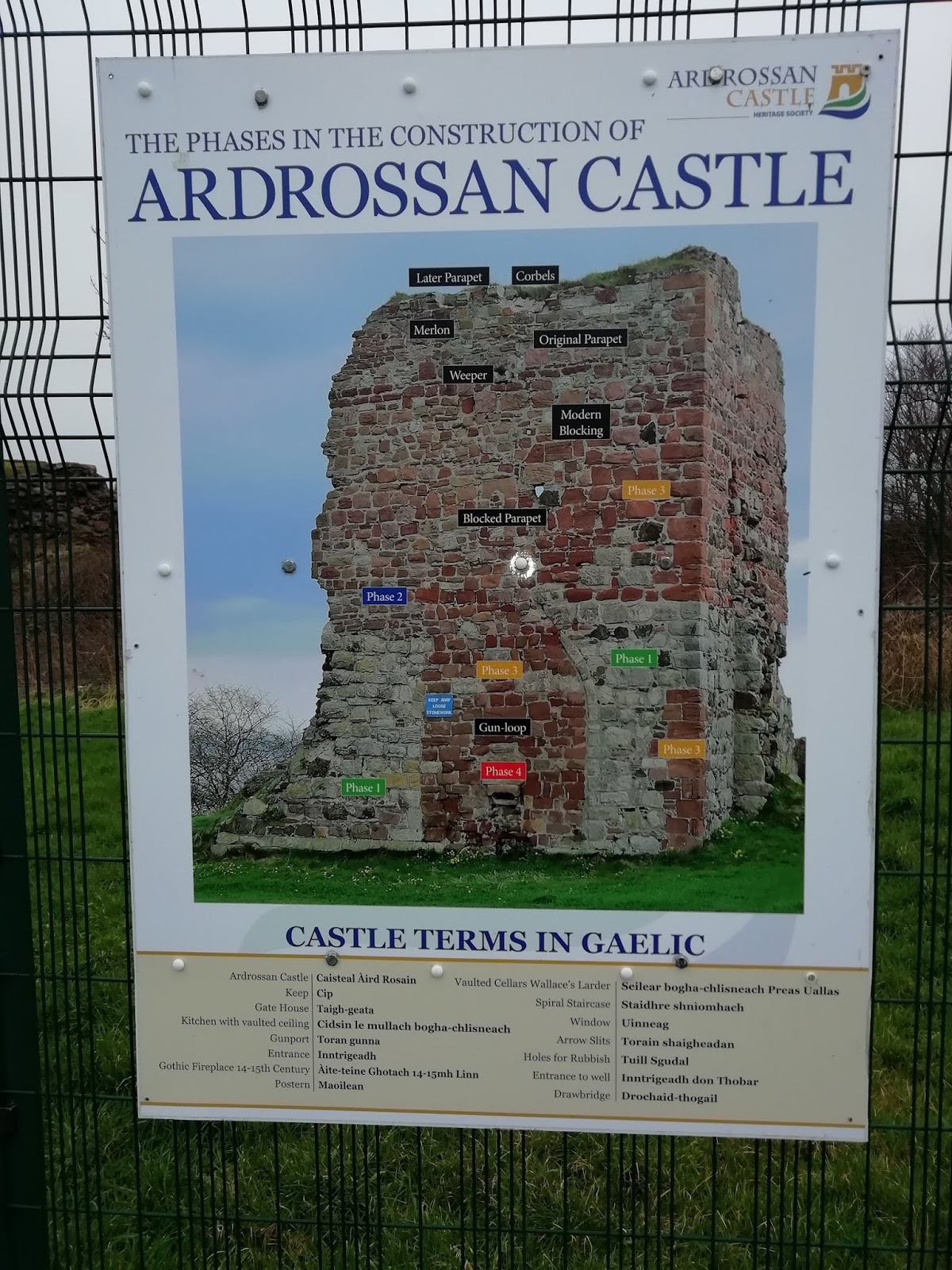
Ardrossan Castle...is it Haunted?


Ardrossan Castle: I had to stick my hand through the bars in the fence to get a good shot.

I know posts have been a little slow so far this year. I've had a few health issues that have kept me indoors. I've resolved to take better care of myself because i get severe cabin fever. So instead of my planned trip gold panning this week I took the physically easier option of going on a mini road-trip.

I headed west for a change, sick of not finding the Elie Bay Rubies I've been out three times to look for. I decided instead of doing anything strenuous I would find something creepy to go look at - and that's how I ended up at Ardrossan Castle.

Ardrossan Castle sits on Canon Hill; a ridge above the town itself. Visible from the bay at Saltcoats (a popular tourist town) it was first constructed in the 12th century. It was partially destroyed after the Scottish Wars of Independence and then it was rebuilt by the Clan Montgomery in the 15th century - only for Oliver Cromwell and his cronies to come along a couple of hundred years later and steal all the masonry to build the Ayr Citadel. The less said about this historical fiasco the better.

What interested me in this tourist spot was not the history - but the legends! In my constant quest to find spooky locations I came across a story about William Wallace wandering the ruins on stormy nights. Now I have lived in both Ayr and Lanark: two very creepy towns both associated with Wallace. So it peaked my interest. There is a second legend regarding a famed horseman known as Sir Fergus Barclay. Nicknamed the De'il o' Ardrossan, this man reportedly traded his soul with the devil in order to be a better horseman. The Devil gifted him a magical bridle which allowed him to become famous - but Barclay later tricked the devil into giving back his soul. In anger the devil attacked his castle, leaving his hoof prints embedded in the very stones themselves.

As well as the lovely view and the castle (which is now all sealed off from the public because it is in ruins, although you can walk around the fence) there is a monument up there. This was erected to Alexander MacFadzean (pronounced Mac-Fad-Yin) in the 19th century. Dr MacFadzean contributed to turning the town into a Burgh, helped install a police station, contributed to the gas, water and electricity supply outside of town and was a general all-round good guy. A monument seems fitting.

Alas I saw no hoof prints, saw no ghosts, and the spectacular view from whence I should have been able to see Arran, the Ailsa Craig and other stunning craggy mountains actually looked like the photo on the right there because it was windy and miserable. I'm sure it's stunning on a nice day!

So After a look around and a bit of a climb I got back in my car and headed down the coast to Dunure... which also has a castle and which deserves it's own page. Until next time; happy crystal hunting, Scotland loving and writing... you are a truly diverse bunch!


Wednesday, 23 January 2019

A Walk Round Wilsontown

(What's left of) Wilsontown Inn as seen from approach

So, after a pretty heavy week and having to replace a smashed laptop screen (thanks Spelectronics, I'm lost without a laptop)I finally managed to do something productive.

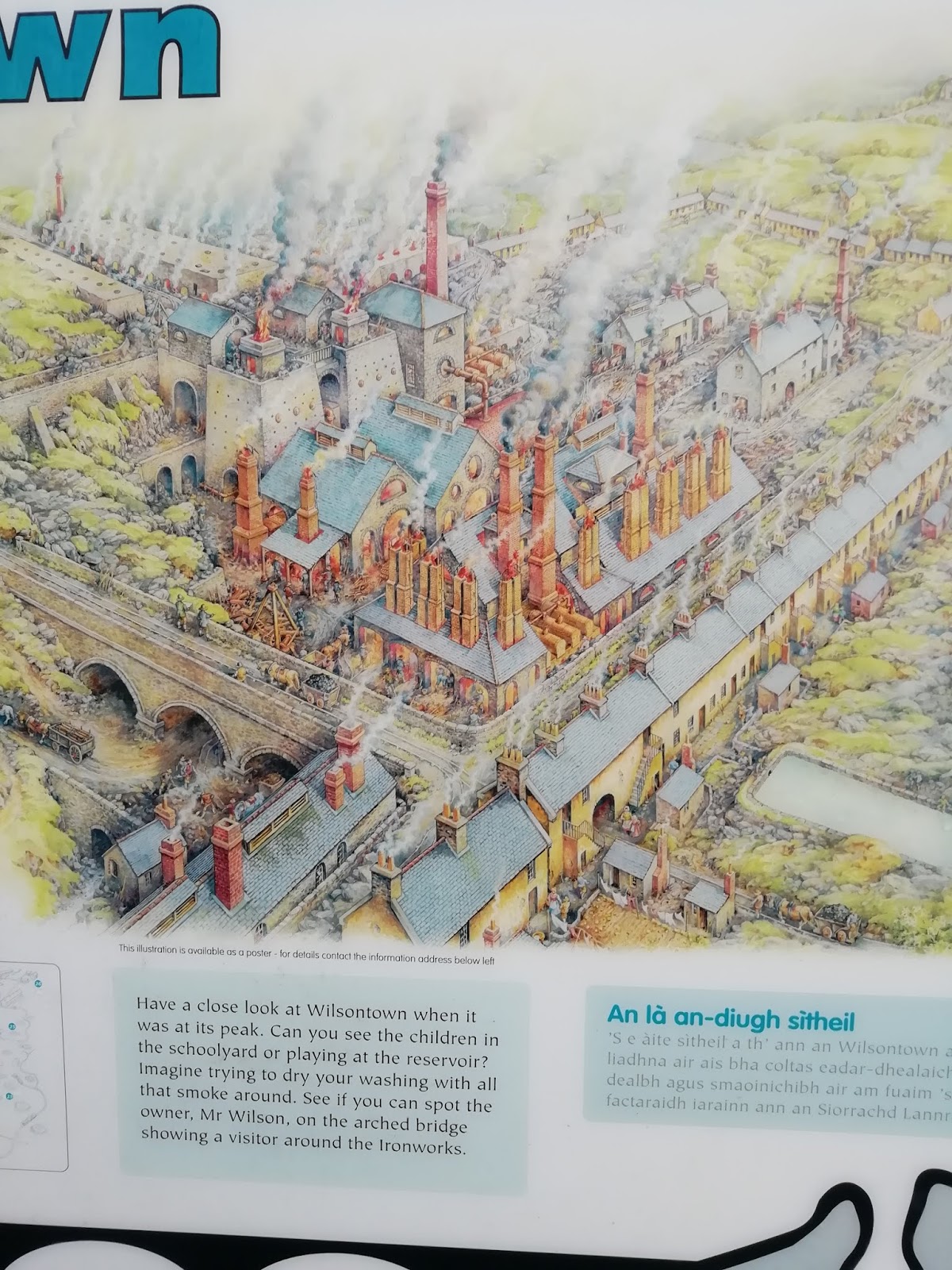
How it once looked...
...Versus how it looks now...
I have been out to Wilsontown (Forestry Commission)before out of curiosity. It is an old Iron mining village nearby where I live in central Scotland that has been preserved to a certain extent. Really it's a nature reserve now, home to some lovely animals which I will attempt to spot for you in the summer and the property of the Forestry Commission. As it was I was walking the dog at another local beauty spot (Braidwood Pond, Carluke Gazette) and met a man who was born and raised in Wilsontown. He was able to tell me that it was a true iron mine and they pulled the ore out of the ground and processed it in the same place...so I had to go back for another look.

looking over the car park where they added a picnic area
It was cold, it was dreary, it was a typical Scottish January out on the moors that make up most of the surrounds to Wilsontown nowadays. The theory I am working with is that where you find Iron deep down in the Earth's crust, is the same area that you find gold. Now people have published all sorts of theories (Science Daily) on this and I find it interesting. It happens that when iron miners do find deposits of placer gold they tend to be so small that they are not worth commercial mining, So...I put two and two together and arrived at the idea that where there are iron mines there might well be gold in the water... even though Geology Scotland says there are no gold faults between the lower highlands and the southern uplands...

Ya never know unless ya try, right?

kai at the start of the pathway.
Unfortunately since this area is a nature reserve there is no way in all the hells I would attempt to pan it. Upstream or downstream perhaps, but having checked it out the water is still pretty polluted. There is a lot of rust, iron waste, smelt, rubbish and all sorts of bits of yuck in there that you don't want to put your hands anywhere near. Certain places are not safe to pan because Tetanus.

What I did find, however, was an astonishing little site where you can walk around and get a real feel for what a working mine might have operated like. You can still see the piles of tailings from where discarded rock was dumped on site. Some of the buildings are still standing, although they are unanimously in a state of disrepair. The best preserved of these is the Wilsontown inn, probably the last building to fall silent when the site closed down in 1955. Scotland suffered a huge industrial setback around that time that saw many of our industries suffer... It was a long, bleak period for us that culminated in the emergence of Thatcher. But the less said about that the better. This is not a political blog!
a commemoration of the achievements of the workers

There is some interesting artwork cast into metal on the gates that makes for nice photography...probably...if you don't have shaking hands and no eye for it...Kai had a good sniff around though. As you walk around you come across conveniently placed noticeboards that tell you a little about the history (3D CAD). A total of three inventions were created here, one of which was the warm air introduced into the furnace made better iron than cold air, which all ironworks previously believed. The forestry commission did well to commemorate this little piece of history in plaque form when they planted the trees back in the early 90's.

Definitely of interest to my rock loving brain was the format of the land. Even as you turn the first corner you can see the dips and furrows where things used to be. At times there are circular dips in the ground that you cannot explain and there are signs warning you to stick to the path. This whole area is subject to pitfalls (there was one in Glasgow very recently) where the ground simply caves in due to the tunnelling underneath. At any rate when you look over the land you can see the shape of how things used to be.

There is a lot of history in this place, from the wounded burn that runs red in places to the other side of the car park, where people still live and where nature has thoroughly reclaimed the site. It seems so strange that one side of the site should be desolate moor and the other should be beautiful natural habitat for birds, butterflies and wildflowers.

Also of interest are the bits an pieces of buildings that are all that remain of this once proud community. People grew up here. Children made friends and played among the tailings. Families were raised on the bread and butter this mine provided. Yet losing it to time is beautiful in its own right. We are moving on from what we once were maybe. Maybe not. Maybe it's just another used up natural resource. In any case the Wilsontown inn still stands proudly, its own little placard declaring it was thirsty work in Wilsontown. I'll bet it was. I'll bet we'll never know exactly how thirsty, either.

The Wilsontown Inn, location for that horror film I'll script one day.


Friday, 7 December 2018

Rock picking in scotland


One of my favourite passtimes is to go out into this fabulous wilderness that surrounds me and retrieve mineral samples. This started as a lifelong interest in crystals, their healing power and their downright prettiness and has led me to some astonishing natural landscapes in the short year I have spent on it so far.

The photograph to the right is actually from a public park as you enter Kilsythe from the east. Dog (Kai) and I climbed to the top of the cliff face to look for rocks. This is the view from the top. There were some beautiful views but no visible quartz veins or other evidence of good veins.

Although this location wasn't successful the areas both north and south of where I live are littered with good finds.
Glencrieff Mine
The location to the left is Glencrieff Mine that lies just outside of Wanlockhead, the highest village in Scotland and home to the Lead Mining Museum. They call this part of Scotland "God's Treasure House" and do so with good reason.

There are three main veins that dissect Scotland and are of geological interest. The first dissects along the Southern Uplands range, the second along the Tyndrum band and the third can be found north again, this time up as far as Helmsdale. Understand that these veins run all the way across the country and are not limited to those areas.

This Calcite formed on hardened dirt

This means that all of these areas where gold is found is actually also prime crystal picking territory. The Calcite crystal sample to the right actually came from the mine pictured above. Calcite grows in absolute abundance here. You can't throw a stone without finding that stone is made of Calcite! These crystals are often growing on or around rock and are usually combined with other minerals from the area, such as Pyrite and Galena, which is a deep blue-grey when found in this locale.
Calcite Crystal from Wanlockhead, Scotland

The Calcite crystals themselves are mostly white and off-white. Some are yellow and some are stained red while some are growing from Galena leading to a beautiful silver blue hue on the surface crystal.

I learned early on that the make-up of Calcite means it will bubble when you put acid on it. This didn't stop me leaving a few pieces in vinegar to see what would happen. Within moments the vinegar turns black and murky as it starts to dissolve the dirt molecules. Unfortunately it doesn't stop there, and it will move on to destroying any aged calcite crystals that are breaking down already. Ultimately you will be left with only the strongest of the crystals and even these will be coated with a powdery dusting of dissolved calcium.

Possible Pyromorphite from Wanlockhead, Scotland


Interestingly, if you put quartz into acid it won't bubble. So if you ever find yourself with an unknown clear crystal formation and you pop it into vinegar the Calcite will produce small bubbles while the quartz will not! Not so common in this area but still found are Pyromorphite and reportedly Flourite, although I have yet to find any. Gold too, of course, though all I ever get in my pan is flour gold too fine to amount to anything.


My rock box, where crystals go to be cleaned 
Traditionally, Scottish rocks consist mainly of agates. Agates are easily identifiable as multiple layers of colour all inside one stone. You do get sandstone like this too but it is very easy to tell the difference just by feel alone. An Agate found on the riverbed is likely to have the coloured layer exposed whereas one dug out of the fields is more likely to resemble a bumpy potato and be encased in some sort of stone. I haven't had the pleasure of digging up an agate yet.
Kai at Elie Bay


More recently we took a road trip out to Elie Bay in the hope of finding some of the elusive Elie Bay rubies. No joy yet, but we did come across this magnificent vein in the exposed bedrock. I believe it is quartz but I have yet to test it in acid. The theory of Elie Bay is to do with a deep red coloured seaweed dyes the rock red. I don't know if I have been searching the wrong locations or what but I haven''t given up on finding an Elie Ruby yet...

Lastly for today I think, Scotland is home to some of the most beautiful Morion quartz in the world. Me and doag are always out hunting the darkest pieces and actually sell some of it on Etsy. If you happen to be a crystal collector or someone with a tumbler who wants samples get in touch and we can work something out. In the meantime, enjoy the pictures and I will try to keep you up-to-date with my escapades... it all slows down here in the winter though... but I have a whole summer's worth of rocks to sort out meantime!

Morion Smokey Quartz from my collection

You can buy some of these lovely samples for yourself through the Stone Circle page.