It's been a long time since I put together a blog on here. I won't waste your time. I just wanted to let you know that you can catch me in multiple other places nowadays. I don't maintain this blog like I should but I'm not closing it down. There will be future adventures that I will document.
For example, did you know that I started archery? I've been going along to the Vanguard Centre, if anyone wants to join me. I'm hopefully going to be measured for a bow shortly. But back to the point.
You can find me blogging in multiple places nowadays. There's here, obviously, but my rock hounding blog has continued over on The Stone Circle site. If you are here to learn about Scottish rocks, I recommend following that blog or hitting us up on Facebook, Instagram, or TikTok.
You can now find all of my links in a single place over at www.katrionamacmillan.co.uk. That's right, I am now so important that I need my own website. Joking, but it keeps things together. I keep a blog on my own site, where you can read some scripts, poems, or other work. I am setting up a Patreon but when I do it, it will be linked to the website.
I keep a business-like blog over on medium.com, because I am a sucker for punishment. Let's not forget the Hubpages blog either. It's non-stop over here.
If you do nothing else to help out the cause, a Facebook follow, Instagram follow, or Tik Tok share is awesome and I'll take it.
Last but not least: It's Christmas Eve so I raise a glass to you all. Thanks for coming on this journey so far and I hope you all have a spectacular festive period and that Santa brings you more than coal and socks. I don't even think I am getting the socks this year.
I leave you with my super-cheerful Christmas poem for 2021.
Those that follow the blog will know that I am into crystals, big time. Specifically, I am into getting out into the wilderness to try and find them. Me, my dog, and my backpack, can often be found pottering around the lowlands, trying to source the best material I can find.
Recently, this pottering has been joined by another, the original potterer, @rockhounding_fox. A few years ago, it was him that sparked my initial interest in rocks to being with. Of course, I had loved gemstones since I was a girl... but I hadn't realised that they were just lying around up there. In all my foolish youth, I never stopped to think about where the crystals came from... and that's what it is that sets the Stone Circle apart.
We intend to start an online platform where we can sell the conjoined efforts of our many hunts. We learned how to scrub those minerals up so they looked better, how to sand and polish them to a high shine, and even how to cut them in half.
When you come to us for your crystal, the idea is that we can tell you where it was found, when it was found, and which one of us it was that found it. We do intend to trade in old crystal collections and the likes too, but we want to start something new... a crystal store where all of the minerals bought and sold are ethically sourced.
We want crystals we can trace right back to the slope of the mountain or the curve of the river. We want to produce collections of all-natural, non-dyed, non-sprayed crystals that have only been opened, touched, and polished, by us.
We are operating under the premise that each of these stones comes to us for a reason. We are meant to find it a new home, to send it out into the world like a new puppy. Each crystal has a job to do - even if it's only to put a smile on someone's face. We help them perform that task... that's what the Stone Circle is all about.
So pop by the Stone Circle, show us some love, enjoy your visit and browse a fine collection of Scottish minerals. You can read about the finds on the blog, even if you don't want to spend anything. You might find the thing you are looking for. More likely, you will find something that helps you attain what it is that you're looking for... Crystals can be fickle that way.
Besides, if it's the universe that's offering, it's rude to say no.
There are
loads of beautiful rocky riverbeds in the west of Scotland, although one or
two are protected, or have nesting areas for rare wildlife. As usual, always
double check if you plan to have a visit yourself.
Onto the
rocks!
Finding Pink Pectolite
I first
came across pink pectolite when I was out on the trail for jasper. Some of the
best red/yellow jasper in Scotland comes from Ayrshire. I spent a lot of time
hunting it down, as regular readers will know.
So in
between trawling rivers and doing a load of reading, hanging out in the
Campsies and checking the River Clyde for some lovely yellow/black lined jasper
- I stumbled across this weird pink rock that looked a bit like salmon. A bit
of research led me to realise I had been in the right location for pink larimar
pectolite - which I had found completely by accident.
Just to
be clear: I went on a hunt for the most common rock in Scotland and found one
of the rarest types of rock in the world. It's only known in a few places...
not unlike the original brightly coloured blue/green of pure Larimar - which is
only found in one single place in the entire globe.
What is Larimar?
Larimar
is the trading name assigned to blue pectolite, specifically found in the Dominican Republic. Pectolite is a fibrous stone with a hardness of between 4.5 and 6...
making it easy to shape for us hand polishers. It has a perfect cleavage with
crystals all facing the same direction, and it is opaque. If light comes
through your larimar, it is probably a fake (sorry).
What the
relationship between pink pectolite and larimar is, is that one is blue, and
one is pink. They are of the same mineral family. The name "larimar"
is just used to describe that specific, blue-coloured pectolite. It was
discovered in 1974 and has grown in popularity every year since.
What is Pink Pectolite?
On the
other hand, pink pectolite looks very much like salmon. It is a pinky-peachy
colour normally, but I have come across pieces ranging from white through to a yellowish, almost agatized
colour. Other locations that contain pectolite report it can be purplish,
greenish, or even grey in colour. In the rivers of Scotland, the
pectolite is pink.
Larimar
and pink pectolite have the same crystal structure. They are found in different
places, and larimar may be dark blue, light blue, or aqua green. Larimar is
also pectolite and belongs to this group of minerals. I hope I am explaining
this clearly enough.
Interestingly
enough, some of the pieces we come across have a black face or black sides to
it. We thought this was bedrock but Minerals.net have this as tarnishing due to air
exposure. The pieces we found have come from the water, so we are assuming air
exposure isn't a factor. They record the hardness as 4.5-5, although admit that
when tightly packed, the fibres of this crystal can make it denser. Single
crystals are rare because they would be so soft that they would erode on
touch.
The
crystal structure looks exactly like you had cut into a salmon fish finger on these
stones. The pink is lined, all usually radiating out from a single point. This
means you sometimes come across sort of star-like formations in the grain of
the rock. We have found a few pieces of stone with the ghost-shape of a missing
pectolite crystal formation imprinted in it; the pectolite having been so soft
it was worn away.
Where
does it come from? We were recently in Angus and brought back some suspiciously pectolite-looking
specimens to cut with the new saw and get a good look at. It just might be we
found an unknown source right here in Scotland.
From now
until I give up on the idea, Fox and I will be collecting, shaping, and
hand-polishing pieces of pectolite. Some will stay as specimens; others will go
out as jewellery. To date we only have a few pieces, but we are working on it.
They will be listed as they are ready, on the Stone Circle site.
The Meaning of Pectolite?
Before we
wrap up for the day, and as always, I wanted to cover the spiritual meanings
associated with the pink pectolite stone. This gem is a sweet replacement for
rose quartz, said to imbibe the wearer with a deeper sense of peace and
relaxation. If you are suffering from anxiety, wearing some around your neck
should help you maintain a calm composure.
Some sources say
that pectolite is incredibly useful for those overcoming addiction,
behavioural, or emotional problems. Those going through grief or experiencing
trauma will benefit from wearing a piece of pectolite, since it helps to
balance out extremes of emotion.
The
colour of the pectolite that you wear will also affect its impact on your life.
Pink pectolite is extremely rare, only being found in two or three locations
worldwide. It is thought to reward the divine feminine in you, honour your
emotions, and embrace realisations of the self. It is a wisdom stone. If
enlightenment is what you seek, then add some to your collection and meditate
with it.
Larimar
is said to be excellent for clearing blockages to the throat chakra. If we had
to guess on the pink pectolite, we would say it affects the same chakra, since
the makeup of the stones is almost identical.
A Note on Thomsonite
Let's
just clear this up once and for all... Thomsonite and pink pectolite are two
different minerals. Thomsonite does not always have perfect cleavage, and has
orthorhombic crystal structures, as opposed to the specific triclinic crystal
structure found in pectolite. They look a little like each other, but they are
very different minerals. Beware of sellers marketing Thomsonite as pink
pectolite to you. Ask where the crystals came from, if it isn't the west of Scotland, then the pink pectolite they are trying to sell you is likely to
be pink thomsonite, instead. You can always read the Wikipedia pages on the two
minerals to clarify. You will find both Pectolite and Thomsonite on there. Be aware that you get either
mineral in different colour variations, too.
And that
just about wraps it up on pink pectolite. If you have managed to buy a piece
from us - congratulations! If you buy it in late 2020/early 2021, you will be
one of our first pectolite customers, which is something to celebrate. It will
have been picked, brought home for a clean, polished by hand, and
wound up at your door. If that's not an ethically sourced mineral, we don't
know what is. Enjoy your new piece of pectolite and be sure to tell us if it
does what it is supposed to. It's the last few days of 2020. We could all use
less stress in our lives.
For the last few weeks I have been playing host to a good
friend of mine. Some of you know him as @geometric_fox already, or by his
rockhounding handle as @rockhounding_fox if you follow the Instagram page. His
other handle is Kev and he is a German spraypaint artist by trade... though
there's a bit more to it than that.
What's so special about this particular German? He's not
just a spraypaint artist, he's the OG rockhound. The one that first handed me a
lump of quartz and asked me why I wasn't picking it up because it was
"Lying around everywhere up there - and you can just take it!". Fox is the dude that first got me into rockhounding, sparking 3 years of adventures
all over Scotland... hopefully with many more to come.
As you guys know, lockdown, quarantine, and random rules
keep separating us and I live with Kai, who doesn't speak much. When we heard
it was coming, Fox packed up his spraypaints, grabbed a six pack of opals (I'm
not even kidding) and crossed the sea so we could spend it doing fun things
like picking through farmer's fields, climbing hills and mountains, and getting
stuck on top of piles of rocks in the dark.
It's been a blast so far, but we want it to continue. With
the markets closed and no relief on the horizon, we have made the group
decision to list some of his art and rocky goodness in the Katriona's Rocks
Etsy store. Which is why we are here today, writing a blog to explain why I'm
suddenly stocking spraypaint art and the occasional opal.
Introductions are out of the way, so let's dive straight in.
I asked Fox some questions and here are his answers... Don't forget you can
find information on all the rocks you get from me/us through this blog, so stay
a while and have a look around.
What to ask a German Spraypaint Artist...?
You all know I do rocks and writing, it was genuinely difficult to do an interview! What do you ask a German rockhounding spraypain artist, anyway? It went a little something like this...
What Inspires you/what brought you to art?
I was always really creative and always very drawn to
painting pictures when I was a kid. I grew up in an area where graffiti art was
a big thing and you saw it everywhere. All these different graffiti’s on the
trainline were super impressive, so I started to create some letters and
graffiti for myself.
I got into spraypaint art when I was about 13 and my
interest in it just kept going. I went to art school for a couple of years and met
lots of other different types of artists, but I always knew spraypaint was my
preferred method. I painted for years on walls, then I wanted to use the medium
of spraypaint to get my ideas on canvas.
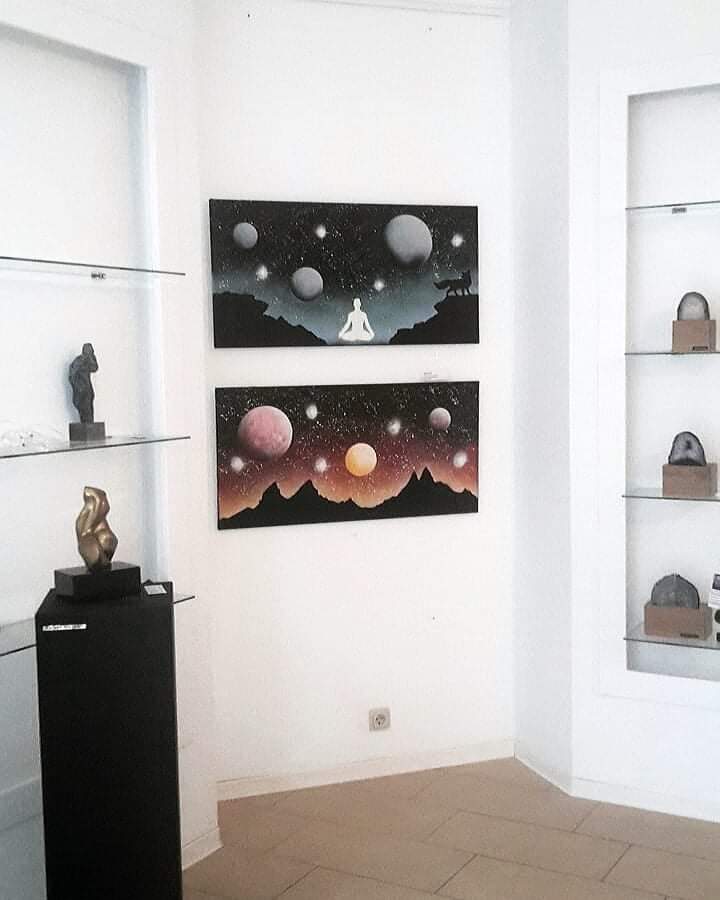
The planetary pictures are inspired by meditations. The
pictures come to me when I am meditating.
You mentioned meditation, how did you come to create art by
using such a spiritual method?
<he repeats the question a few times, English isn't his
first language>
I lived in Australia for seven years and got really into
lots of meditation practise. I decided I wanted to capture the pictures that I
see in my meditations and transform them into something artistic. My artwork is
super inspired by the universe. For me, art is just an expression of my
feelings and emotions and it's really hard for me to put that into words.
Do you have a favourite artist?
My inspiration is life and what happens during it to create
this connection between the 3D world and everything else. I'm inspired by
nature, by people, but not really by other artists... I'm not that guy.
(My best
friend is probably my favourite artist but he doesn't have an @.)
The reason I got back into painting was because of Covid. I
was working markets selling rocks and the odd artistic piece, when everything
shut down I had lots of time on my hands to pick up the spray cans again.
Your paintings seem to have two main themes. Some are
geometric prints, and some are universe themed. Can you tell us a bit about that?
Yes, the space themed art and the geometric abstract art.
Argh it all goes so deep. I can't explain it in a few words. The reason I do
the geometric stuff is sacred geometry, which is something you can't explain without
time. Sacred geometry is the source of everything, what we are all made of. I
like to play with the patterns of sacred geometry, then as well play with the
3D forms.
How big an impact does colour have on your paintings?
I like to use natural colours. It's not something I'm
thinking about that much while painting. It's just what is in my head at that
time. I like a nice fade between dark to bright, but if you met me in person,
you'd see I dress in greens and browns to tie in with the trees. I spend a lot
of time in the forest.
What was your biggest exhibition?
I had one in an art gallery in Germany, but my favourite
exhibit was one where we put art in all the empty buildings in my home town. I
am always travelling around the world, so I usually do a lot of live painting
when I am on the market circuit.
Got any videos we can share?
Yes, but it's super German. It's from the exhibit in the empty buildings of my home town.
<The video in question>
Last question… How did you come to be a rockhounding
artist?
How did I become a rockhounder? Ooh that's hard. It has nothing to do with art. So…I was always obsessed
with stones. Like when I was a kid, I found them really fascinating. When I
moved to Australia, I felt like I had returned to my roots and as time passed,
I got to know myself better. I discovered the magic of the different rocks
around the area there.
Rocks are everything to me, I don’t know how to explain it.
I am here to bring the rocks out of the earth and get them to where they’re meant
to be, It’s as if they speak to me, talk to me, everything. It’s my purpose in
this world. I hate to talk about myself like this and I hate that I can’t put
into words what it is that drives me. It’s like I am part crystal myself… and
you don’t have to tell me how crazy that sounds… but it’s just the truth.
You can find out more about @geometric_fox in a previous interview by We are Superheroes. Don't forget that you can catch some of his work on my Etsy page, or that you can drop him a follow and make an offer if you see something you like.
It's been a while since I wrote an update on the southern highlands and I've learned a lot since I started going there. Nowadays, I know better than to go up in the ice and get stuck. I might have more common sense but I'm still quartz daft.
I was up there on the 27th of December '19, then again in February. I was going to go in March but 2020 happened. Between murder hornets and bat plagues it didn't seem like a good idea to be on any mountains for a few months. I was back in August, then again to show a friend the area in the start of November.
The November trip was crazy. The water was higher than I had ever seen it. I try not to pick much now because I have enough quartz, but the odd piece still catches my eye.
I have found a fair amount of pyrite up there, as well as garnets, mika schist, rare rutile, lovely smoky, and goethite, which forms on the pyrite to make it black. I only just learned on Brittanica that the goethite forms as a result of weathering iron compounds. It makes sense that it would be there because the mountains are wet. Just all over.
I was at some mines in Spain a few years ago and I am always fascinated by the difference in the hillsides. Our cliffs are craggy and crumbling. Our mountains have bedrock made jagged by streams carving out paths. Spain's mountains aren't like that. They erupt and only spend a few months wet. They crack and dry and crumble in the sun. I always thought it was an interesting comparison.
Quartz crystal
Pyrite with goethite coating
Rutile on Quartz
Garnets in schist
Remember!
I'm not a geologist and I do this for fun. I really don't know much more than what I pass on to you guys. However, you can join me on Facebook, Instagram and other places if you want to keep an eye on my rock finding adventures.
You can find my old post on this are, in which I got my car stuck up a mountain, here.
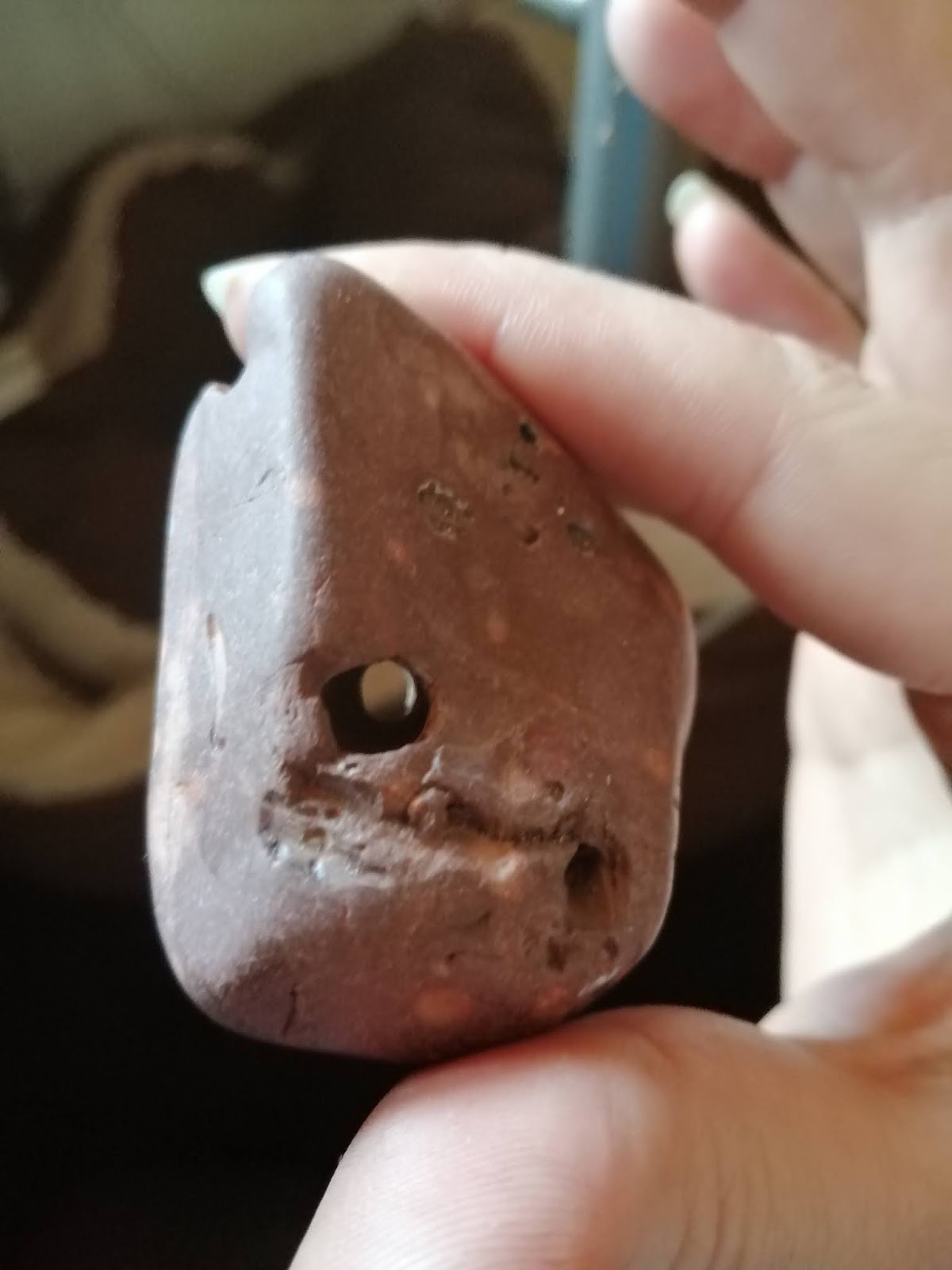
I was just reading through some of my old posts there. I had such a hard time identifying that jasper and now I see it all over the place. Today's topic is hagstones, and the only examples I have at the moment are jasper hagstones. I wanted to create a page for these, to go along with the legend.
Recent movies and TV shows have made hagstones unerringly popular as part of the pagan/witch culture. Legend has it that you can see the fae, or fairies, through these special stones. Of course, there is a geological explanation that I'm not nearly skilled enough to define. Let's start with the basics first... What's a hagstone and why do you want one?
What is a Hagstone, Anyway?
Put simply, a hagstone is any stone with a hole bored into it. It can't be a man-made hole and has to be all-natural for it to be counted. They are much rarer than normal stones and were historically prized since they were easiest to polish and stick a lace through to make jewellery. It's feasible that the legends surrounding them grew from those who sold such necklaces as a way to make them sell. What we know for certain is that crofters in Scotland would often sell found crystals and stones to make extra income.
How Are The Hagstones Made (Really)?
If you are under ten years old, they are made by fairies. They want to let little children have a glimpse into thier world without having to take them away forever... because fairies are nice like that.
If you are an adult? There are two ways. One is by tiny stones caught in a tiny whirlpool. With a repetitive current and a few years' time, the tiny pebble will wear away the mountain...or the slightly bigger stone, in this case. There is also a type of clam which burrows into the stone and weakens a spot, allowing the water to wash through. Either way, the holing of a stone takes a lifetime, and that's what makes them special.
The ones I have provided photos of in this post are even more special because they are inside jasper. They are the only two examples I have come across yet in three years of looking at rocks.
Nicknames and Legends About Hagstones
So... A Hagstone is called a Serpent's Stone, an Adder's Stone, and multiple variations of these names. Ancient Germanic folklore has it that they were made from serpent's poison/bile/saliva, or that they are serpents themselves. The ouroboros is symbolised in connection with them, and they were used in areas along the coast of the Baltic Sea to ward off evil.
In Scotland, we have different legends about the hagstone. We called it a 'hagstone' because they would be used to ward off witches. That the witch community now use them for charms speaks volumes.To htis day, some have them as protective charms used in fertility magic or in the protection of livestock. They suggest that the stones were used to ward off ailments created by invisible witches - or hags. Basically, some believe the hagstone can break curses.
Other nicknames include the Holey Stone, although it is perhaps a different type of holey than we are used to.
If you have bought a Hagstone from the Stone Circle, then your stone came from Ayrshire unless otherwise stated. You will also find a video of the jasper hagstone on my YouTube channel, here.
The Story of Scottish Hagstones
Somewhere in the midst of all this, there will be the truth. We're not saying the Scottish version is the true version, but it is what the Scots ought to be taught in schools. This legend involves the Seer o' Brahan, of Clan MacKenzie. This man has long been considered to be the Scottish version of Nostradamus.
Back in Ancient Scotland, to be given the two sights (to be psychic) was not considered to be a good thing. At one point you would have been executed for witchcraft. I don't know if I have mentioned this before but half of my own clan history comes from a place called Crawford, where ten witches were executed. There is a great witch record via Edinburgh University which you can use to track the witch trials throughout Scotland. Anyway, Crawford has around twenty houses. That ten witches were killed there is harrowing.
Back to the Seer.
The Seer of Brahan is renowned as having predicted the deaths of the clans. He could tell each of the major highland clans, in great detail, what was coming for them. People came from all over Scotland to have conversations with this man. There is a record somewhere of a whole bunch of his recorded visions that his scribe tossed on the fire because he believed it was too nonsensical. Having lived through murder hornets and 2020, I believe I know why.
This seer wasn't always destined to be a seer, however. There is a legend that before Kenneth Mackenzie, AKA Kenneth of Sallow, Coinneach Odhar, and the Brahan Seer, was born, his mother was known to commune with spirits. One night, she waited and watched in a graveyard where spirits were known to roam. Once there, she saw a Danish Princess strolling as a ghostly vision. Kenneth of Sallow's mother demanded a tribute from the Princess before she would allow her to return to the grave.
The Danish Princess gave her a hagstone - a blue and white stone with a hole in the centre. Kenneth later used this as his instrument of prophecy. When he looked through it, he could see the future... and many of those visions came true. Most famous of all was when he saw the moors of Culloden for the first time. He told his fellows that many a Scottish head would be lopped off on this field. It was really quite uncanny.
A stone with a fairy ring of its own, from the Highlands
All Legends Contain a Grain of Truth
Some stories have it that the seer was already born when his mother met the princess. Some have it that he found the stone on his own. Some make no mention of a princess, and talk of a witch, or a spirit, or a ghoul. Whatever the case, by the time he was burned for witchcraft he made thousands of prophecies. Since the Scottish had a reckless history of spreading tales via word of mouth and nobody ever wrote anything down - we might never know for certain what they all were.
We do know he existed, he was famous, and that people flocked to hear him speak. All from one little circular stone with a hole in it. So in Scotland, you might also hear of a hagstone being referred to as a seer stone, particularly if it happens to be blue and white.
This is the briefest blog ever. I am in the process of setting up an Etsy shop as a switch from Ebay (whose fees are making selling rocks a little pointless).
If you came here to look at rocks then head to Etsy by following this link. If not - carry on. Forget I said anything. Also, I highly recommend reading the one about Wilsontown. It's a nice place. Bit windy though.
Please enjoy this discarded book cover photo while you are here.